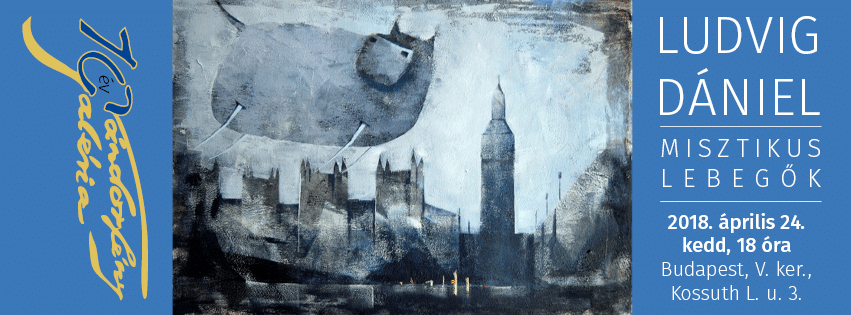
It’s been ten years since we opened our Downtown Gallery, thanks to you, our art-loving friends. Our anniversary year is all about the joy of celebration, and we are opening the exhibition of Dániel Ludvig on Tuesday 24 April at 6pm. We would like you to get to know Dani and his art a little better, so we have prepared a short interview with him.
In contemporary Hungarian art, the name Ludvig is a “brand” in the most positive sense of the word. When did you decide to become a painter?
Sometimes I feel that my father gave me a fait accompli from the moment I was born, but of course I chose to be an artist of my own free will, he didn’t force anything on me. He entrusted my professional career to professional art teacher colleagues from a very early age. In Nagykanizsa, I started to attend Lajos Stamler’s art class at the age of 12, and then I was taught by János Erdős at the Pécs Art College. At the age of 13, I was first invited by our friend György Csuta to the Csuta Art School in Békés, then mainly as an “observer”. From then on, I participated in several summer art camps in the lowlands every summer, while I was working as a commercial artist in Pécs. When I reached adulthood, my father started to organise the Ludvig Art Camp in Kendlimajor in 1999. For 5 years I worked mainly as a commercial artist, painting was a bit on the parking lot. In 2004 I organized my first solo exhibition in Nagykanizsa. Since then I have been working in the direction of fine arts, for about 6-7 years 90% of my activity has been painting sculpture.
Since 1994, I have participated in more than 80 art camps in Hungary, Italy, Slovenia, Croatia, Austria, Germany, Finland, Bulgaria, Bosnia, Malaysia and Azerbaijan.
Since 2004 I have had 21 solo exhibitions in Hungary and abroad, from Bratislava to Singapore, and a similar number of group exhibitions. I am also frequently invited to art expo’s, without claiming completeness : Innsbruck /Austria/, Munich /Germany/, Zaragoza /Spain/, Taipei /Taiwan/. and since 2007 9 times Kuala Lumpur.
How do you start a picture? What is your starting point?
- inspired by a living thing, a plant, a natural form, a building
- composition, choosing the right size for the idea
- some line sketches
- implementation
Of course, images are also created spontaneously, directly on the canvas, but less often.
What are the main challenges you face when creating?
With the occasional emptiness, a creative crisis if you like. This can also be caused by too much work /many exhibitions, art camps/ in a short period of time, and when I am forced to leave painting out of my life for a longer period of time, for example when I spent 3 months putting together the 300-page jubilee book of the 25th Ludvig International Art Camp. The book turned out very well in the end, but it took me out of circulation for 4-5 months, as it was difficult to get back to creative work afterwards.
Your technique is special and spectacular, can we learn some workshop secrets?
I was fortunate to have been able to absorb unconventional techniques instinctively, practically from childhood, through my father, and of course I learned a lot at art workshops. The essence of this particular technique/style in a nutshell:
– with me, a form, a structure, a colour is never finished when it first appears on canvas. Each element in the picture is given multiple “treatments” until it comes together.
How important is the title?
I’ve never had a case where I thought of the title first, rather than the picture. I don’t like to title my own work. My favourite method is to ask you or artist friends what a new painting offers them, and I always come up with the perfect title quickly.
Who is your favourite painter? Which of our gallery artists are close to you?
I have many favourite painters, mainly from the beginning of the last century, of course: Modigliani, Matisse, Picasso. Surprisingly, I think Goya is the greatest painter of all time. Fortunately, I have seen a lot of his paintings in person, but nothing like Goya’s “Execution” at the Prado. It is a mystery how a picture can be painted… I am friends with János Sebestyén and István Korbely, I love and respect their art. I also appreciate the painting of Ede Pósa, Tamás Mág and Tibor Nagy.
How do you see the situation of the art “market”, what is the role of you as an artist and us as a gallery?
I feel that the market is in better shape every year, with a new generation of collectors who are demanding an innovative approach. I have had many exhibitions both at home and abroad, I am not saying this out of obligatory politeness: the importance of the gallery is decisive.
Thank you for the interview and we look forward to your upcoming exhibition with great excitement.